27,892 signers
22,108 more signatures needed to reach 50,000
Sign: demand an end to broiler chicken suffering
810 million chickens a year in Spain. 42 days of life. Systematic suffering within the framework of the law. With your signature, you demand that this change.
Columbus
Ohio, United States.
Is this not your location?
  Your personal data will be processed in accordance with international laws. By completing this form, you agree to our privacy policy.
AnimaNaturalis Investigation

Designed to fatten,
not to live

810 million chickens a year in Spain. 42 days of life. Systematic suffering.

Designed to fatten, not to live

A broiler chicken is not the chicken we used to know. It's an animal genetically redesigned to grow four times faster than it did 70 years ago, to the point where its own body can no longer support itself. In just 38 to 42 days — before it has even finished developing — it already weighs enough to be sent to slaughter. Its bones break. Its heart fails. Its legs can't bear its own weight.

This campaign was born from an undercover investigation on farms across Spain and the European Union. What our cameras recorded is not the exception: it's the system. Every year, more than 810 million of these birds are raised and slaughtered in Spain under conditions that science defines as systematic suffering. The future of chicken welfare depends on legislative change and public pressure.

Undercover investigation

What no one wants you to see

Every year, more than 810 million of these birds are raised and slaughtered in Spain under conditions that science defines as systematic suffering. AnimaNaturalis, together with the Observatorio de Bienestar Animal and Eurogroup for Animals, investigated. This is what we found.

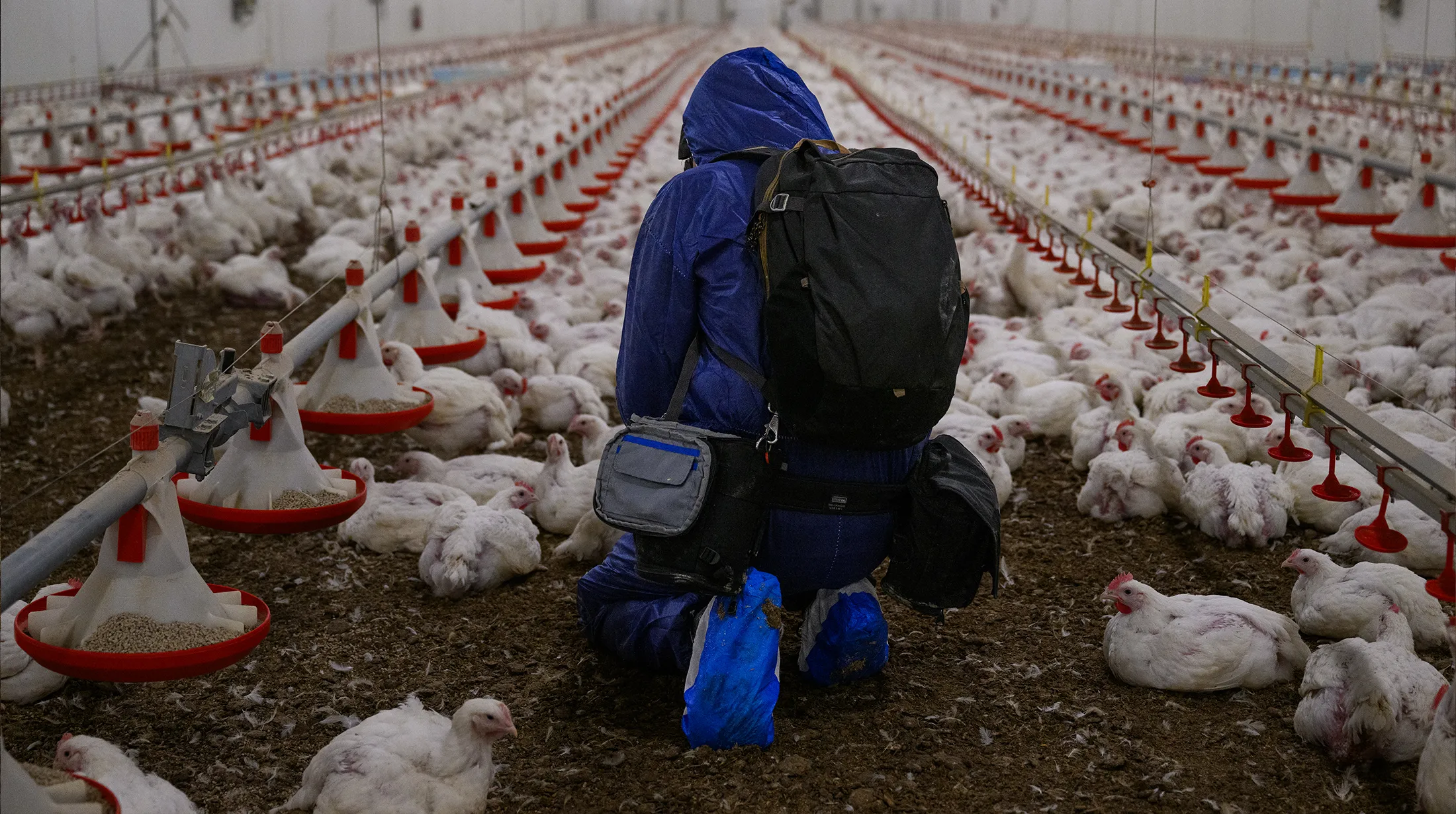
For weeks, our investigators gained access to fattening farms across different parts of Catalonia and Castilla-La Mancha. No scripts. No staging. What they filmed is what happens every day, in legal facilities, within current regulations. These are broiler chickens.

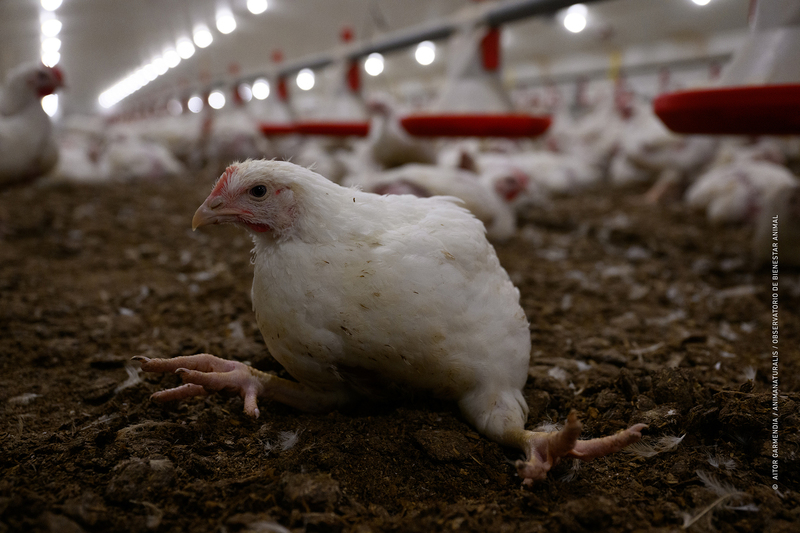
Undercover investigation on chicken farms. Spain, 2026.

The reality of broiler chickens

An animal redesigned to suffer

Artificial genetic selection has turned the chicken into a meat-producing machine. In just a few decades, its growth rate has quadrupled. The result is an animal whose cardiovascular and skeletal systems are unable to support its own muscle mass. Ascites — heart failure caused by pulmonary hypertension — causes up to 12.4% mortality on farms. The suffering is not an accident: it's built into the animal's own biology.

They cannot walk

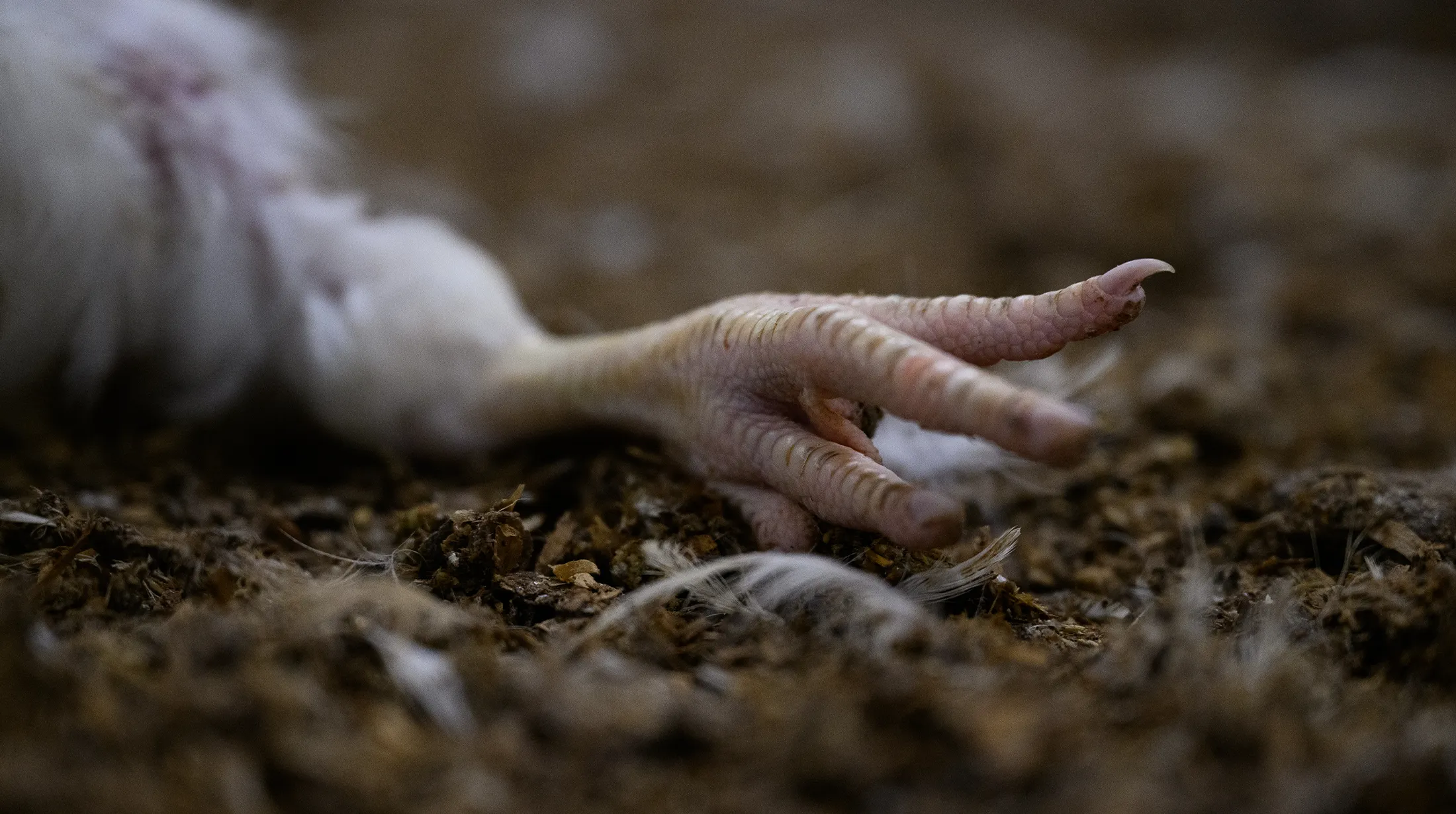
Between 5.5% and 48.8% of commercial chickens suffer from gait abnormalities. They spend between 76% and 86% of their lives lying down, not out of instinct, but due to physical disability and chronic pain. When given painkillers, their activity increases significantly — direct evidence that they live with constant pain. Their legs and respiratory system cannot bear their own weight.

Legal overcrowding, real suffering

European regulations allow stocking densities of up to 42 kg/m². EFSA itself warns that any density above 11 kg/m² prevents basic behaviors such as wing-flapping, exploring, and preening. Royal Decree 692/2010 allows between 20 and 22 adult chickens in the space of a single parking spot. The gap between what science considers acceptable and what the law permits is not a mistake: it's a decision.

Burns, ammonia, pain

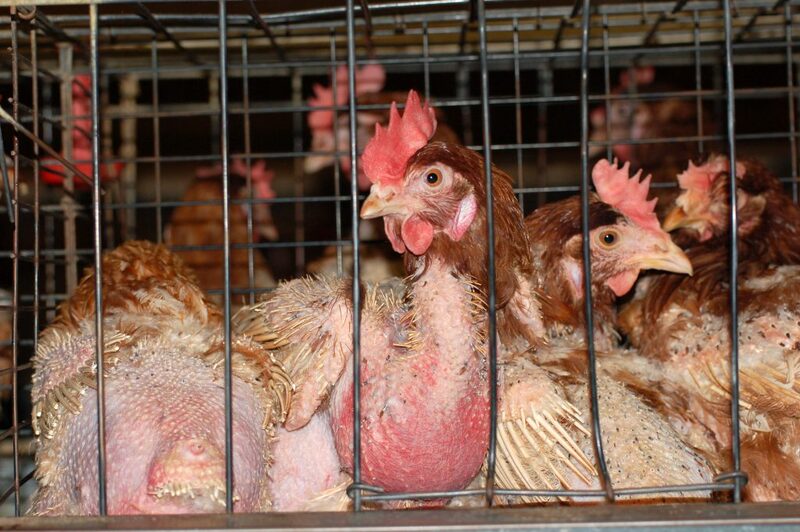
Spending almost all their time lying on accumulated droppings, chickens develop burns on their feet and chests. In some systems, moderate to severe lesions affect 71.5% of the birds. Ammonia in the sheds — at concentrations above 15 ppm — irritates mucous membranes, damages the eyes, and contributes to severe respiratory diseases.

Horror in plain sight

In industrial sheds, the light cycle is set by a timer programmed to maximize feed intake: between 18 and 23 hours of artificial light a day. The logic is simple: an awake chicken eats, and a chicken that eats grows. Regulations require a minimum of 6 hours of darkness, but enforcement is practically nonexistent. The science is clear: balanced light cycles reduce locomotor injuries and cardiovascular mortality.

The numbers

810M
chickens slaughtered per year in Spain
42
days of life before slaughter
41M
die on the farm each year
93 mg/kg
antimicrobials in Spanish chickens (EU avg: 46)

You've seen it. Now you can't ignore it.

What this investigation documents doesn't happen on illegal farms or under exceptional conditions. It happens every day, on an industrial scale, within the framework of the law. And it happens because most people have never been able to see it.

Signing is essential. Every signature tells the industry and lawmakers that #MacroPollos is no longer a secret. If you can also support AnimaNaturalis's investigative work financially, you'll be helping us keep getting into the places they don't want us to enter.

42 days: the full cycle

Days 1–14: They're born alone. And they're already starting to die.

Chicks are hatched in massive industrial incubators and moved along conveyor belts from the very first second of life, with no mother or natural warmth. Mortality in this first phase is high: dehydration, infections, and failures in thermal regulation. Drinkers are set at the height of the bird's outstretched neck, not to make drinking easier, but to keep water from wetting the litter and breeding bacteria. The weakest simply don't make it.

Days 15–28: The only "quiet" week.

Between days 15 and 28, mortality drops below 0.5%. This is the phase the industry calls "feed efficiency": the animals eat nonstop under lighting schedules of up to 20 hours of artificial light. But the damage begins quietly here. If ventilation isn't perfect — and at this density it rarely is — ammonia from the droppings is already starting to burn their feet: the footpad dermatitis that turns into severe lesions in later stages.

Days 29–42: The body collapses.

In the final stretch, mortality spikes again: between 1.5% and 2% of the birds die because their own bodies give out. Their hearts and lungs haven't grown at the same pace as their muscle mass. Density reaches 42 kg/m². When slaughter time comes, workers grab the chickens by the legs at high speed, causing fractures. A percentage arrive dead at the slaughterhouse — what the industry calls DOA, Dead on Arrival — without it ever appearing on any label.

Antibiotic use that persists

The use of antibiotics to speed up growth has been banned in the EU since 2006. However, in 2024 Spain used 29.5 tonnes of antimicrobials in chickens — more than double the European average adjusted for biomass (93.1 mg/kg in Spain versus 46.1 mg/kg in the EU). Antibiotics no longer fatten the birds, but they're still needed to keep alive animals raised in unsustainable conditions.

41 million never reach the slaughterhouse

In Spain, 5.6% of chickens raised — around 41 million animals a year — die on the farm before they can be slaughtered, due to pathologies stemming from their own genetic design. That's more than 112,000 deaths every day caused by induced biological fragility. This figure appears on no product label. Every signature tells the industry and lawmakers that this is no longer a secret.

We demand immediate action

We call for an end to industrial farming. With particular urgency, we demand:

  1. Amending regulations so that facilities allow animals to develop their natural behavior without restrictions.
  2. A ban on the use of ultra-fast-growing breeds on industrial farms.
  3. Maximum stocking densities of 11 kg/m², in line with EFSA recommendations.
  4. A ban on the maceration of live chicks as a culling method.
  5. Mandatory EU-wide labeling that informs consumers about the production system.
  6. Veterinary oversight focused on individual welfare, not just group productivity.

Latest news

New research reveals how 810 million chickens live on factory farms in Spain
28 mayo 2026

New research reveals how 810 million chickens live on factory farms in Spain

A photographic investigation carried out on five farms in Catalonia and Castilla-La Mancha reveals that overcrowding, disease, and skin injuries are not exceptions, but the standard of the system that produces 80% of Spanish chicken. What exactly happens inside these warehouses before the product reaches the supermarket?
Farm animal sanctuaries find themselves in a legal void and caught between two Ministries
04 mayo 2026

Farm animal sanctuaries find themselves in a legal void and caught between two Ministries

Two decrees in progress, two ministries in conflict and no legal category for sanctuaries. While the Government updates — fifty years late — the regulations on establishments that house animals, those who rescue cows, pigs and hens from industrial farming still have no name in the law.
The voice of 300 million caged animals reaches the Court of Justice of the European Union
05 febrero 2026

The voice of 300 million caged animals reaches the Court of Justice of the European Union

On 5 March 2026, the EU Court of Justice will hold an unprecedented public hearing on the European Commission’s failure to comply with the European Citizens’ Initiative “End the Cage Age.” Can European justice compel the Commission to honour its 2021 promise and finally put an end to cages on farms?
The European Commission plans to betray 1.4 million citizens by abandoning the cage ban
20 octubre 2025

The European Commission plans to betray 1.4 million citizens by abandoning the cage ban

A leaked draft of the European Commission’s 2026 Work Programme reveals an intention to omit the long-promised legislative proposal to end the use of cages in farming. AnimaNaturalis is joining the End the Cage Age coalition to mobilize letters and mass actions ahead of the programme’s official adoption on October 21.
Activists and politicians demand a Cage-Free Europe
25 junio 2025

Activists and politicians demand a Cage-Free Europe

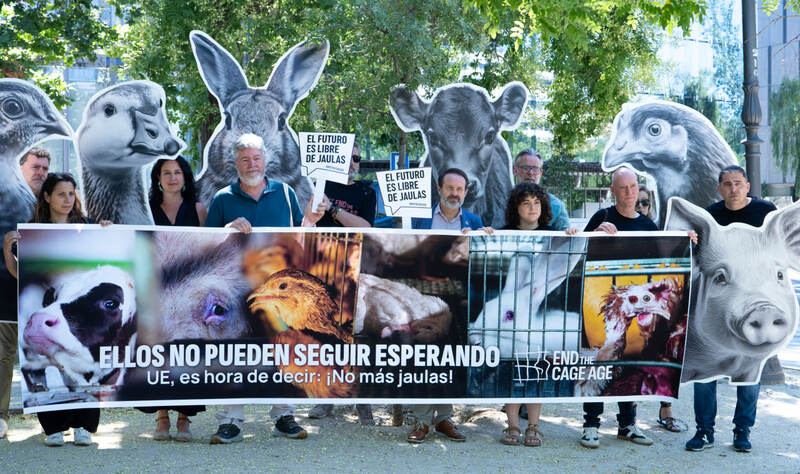
This morning, AnimaNaturalis and its allies from the End The Cage Age coalition gathered dozens of activists and parliamentarians in front of the Congress of Deputies to demand authorities immediately fulfill Europe’s promise to ban cages on farms.
New investigation puts Spain at the epicenter of Europe's megafarm expansion
13 junio 2025

New investigation puts Spain at the epicenter of Europe's megafarm expansion

New report has uncovered that the EU hosts an astonishing 22,263 industrial chicken and pig farms, containing over 516 million animals under intensive livestock farming conditions. Despite this, European authorities advocate for increasing farm animal numbers. But what would this expansion mean for animals, human health, and environmental impact?

Support our campaign

Only you can help end industrial farming and put a stop to the suffering of millions of animals.